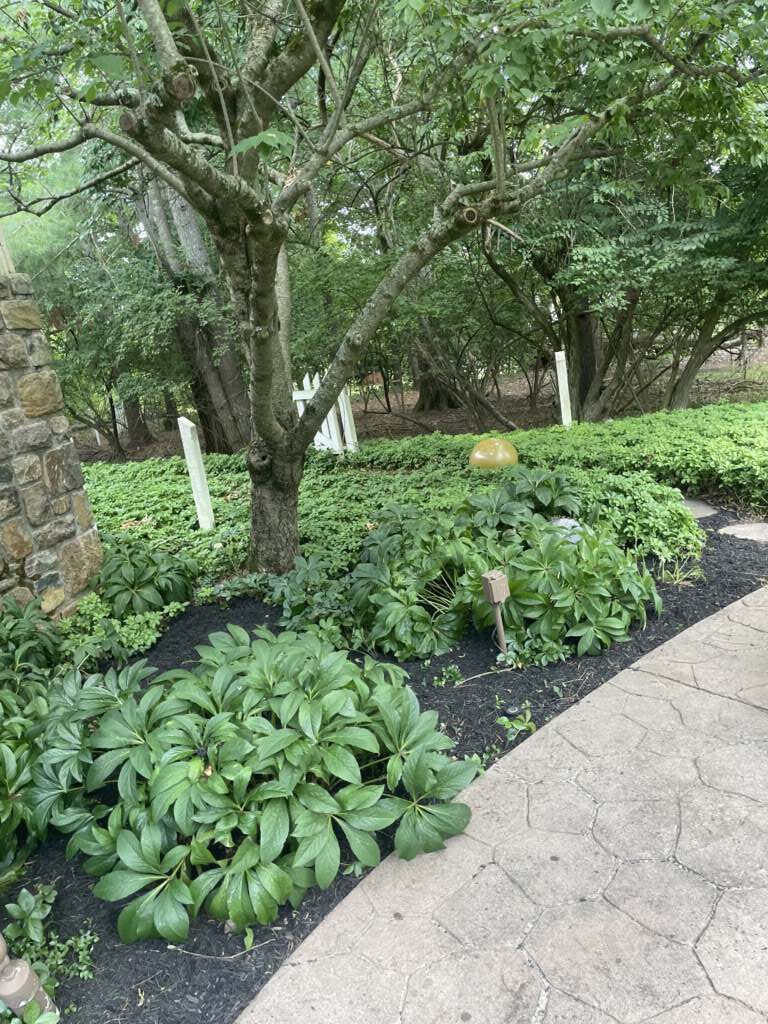
When shrubs win the fight with a walkway, you feel it every grocery trip: wet sleeves, spiderwebs across your face, and a path that feels one foot narrower than it was in May. Windows tell the same story indoors—dim rooms, screens that can’t open, and siding that stays damp after rain.
Clearance trimming is not the same job as sculpting a perfect globe. It’s practical cutting for people, sightlines, and the building. Here’s how to think about it on typical southeastern PA homes.
Why clearance deserves its own standard
Decorative pruning asks, “Does this look balanced?” Clearance pruning asks, “Can someone walk here at night without turning sideways? Can you see down the driveway? Does air reach the wall?”
Those questions matter on compact lots in Montgomery County and along the Main Line, where foundation beds were often planted with shrubs that matured larger than the gap between sidewalk and house. The plants aren’t “bad.” The space is small. Maintenance has to respect both.
Walkways: width, height, and wet-branch slap
A usable walk needs more than a theoretical centerline.
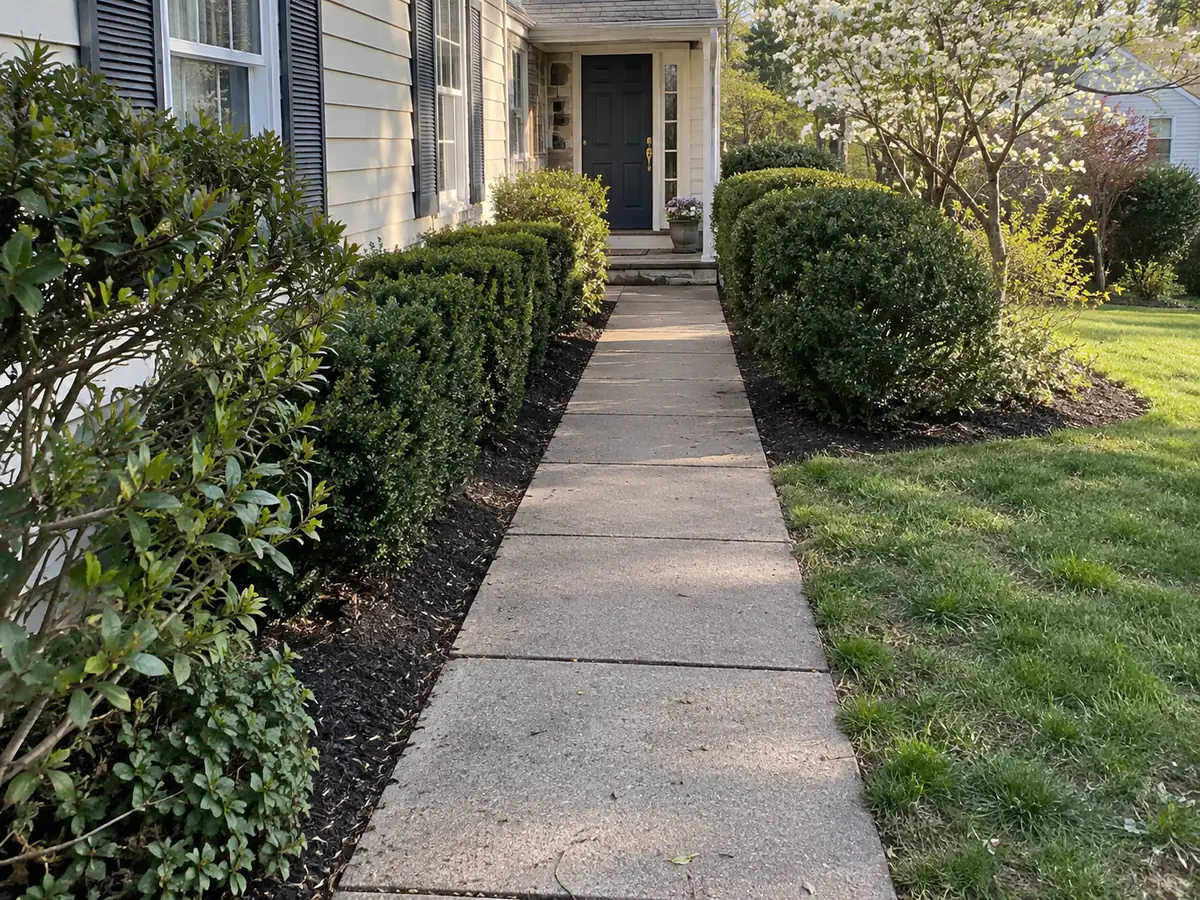
Width. Aim for enough clear space that two people aren’t forced into single file by evergreen elbows. Exact inches depend on the walk width and plant type; the test is lived experience—carry a laundry basket or a bag of salt along the path and see what hits you.
Height near faces. Branches at torso and face height surprise guests more than low groundcover ever will. Raise or cut those first.
Rain and dew. Shrubs that lean into the walk stay wet longer and soak clothes. After a clearance cut, the path should dry like a path again.
Night and ice season. In winter, uncleared shrubs push people toward slippery lawn edges or into the street. Clearance is a safety habit, not only a spring cosmetic.
When you request service, say “walk clearance” explicitly. A shape-only trim can leave the pretty face of the shrub still owning half the sidewalk.
Windows: light, screens, and airflow
Shrubs plastered to windows cause a stack of small problems:
- Rooms stay darker, so lights stay on longer
- Screens and sills collect more debris
- Moisture sits against trim and siding
- Emergency egress windows can be harder to use if growth is thick
Clearance here means pulling plant material back enough that you can open the window, wipe the sill, and see out without a green curtain. You don’t always need a stump. You do need space.
Upper sash visibility matters on front facades for curb presence; side windows often matter more for bedrooms and airflow. Point out which windows are priority so the crew doesn’t spend the visit perfecting a hidden corner.
Driveways and sightlines: the backing-out problem
Corner plantings and driveway-adjacent shrubs can block views of sidewalks and approaching cars. This is especially noticeable on streets with on-street parking and kids on bikes.
Clearance trimming for sightlines focuses on the driver’s eye level and pedestrian approaches—not only the top of the plant. Sometimes that means keeping height but lifting or thinning; sometimes it means reducing width on the street side while leaving backyard privacy alone.
If you’ve had close calls pulling out, mention that in the estimate walk. Photos from the driver’s seat help.
Building clearance: siding, vents, and meters
Shrubs tight to the house hold moisture and make painting, pest checks, and meter reads harder. Leaving a gap along the foundation—enough to walk for maintenance when possible—protects materials and keeps HVAC and utility access open.
Also watch:
- Dryer and intake vents buried in foliage
- Hose bibs you can’t reach without branch cuts every time
- Electric meters and panels that need working space
This kind of cutting is often combined with a broader property cleanup when vines and weeds have joined the shrubs in the same squeeze.
How clearance cuts differ from formal shearing
Power shearing a face flush can give a temporary flat green wall that immediately pushes back into the walk—and it can leave the plant brown inside if it was previously only green on the shell.
Selective clearance often looks more natural: shorten the limbs that intrude, thin density where needed, and keep the plant’s character. Formal hedges are the exception; they expect a sheared plane—but even hedges need a setback from the paved edge so the plane doesn’t sit on the concrete.
Ask which method fits each plant on your property. One yard can need both.
What to put on the estimate so results match expectations
- Paths and doors included — front walk, side gate, rear patio doors.
- Windows listed by priority — street face vs. bedroom vs. basement wells.
- Drive sightlines — yes/no, and from which seat/angle.
- How far back — “comfortable walk side-by-side” is clearer than “trim a little.”
- Bloom concerns — if a spring bloomer owns the walk, decide whether to do minimum clearance now and shape after flower.
- Debris hauling — clearance can generate more material than a light tip-trim.
- Return rhythm — fast growers may need more than one clearance visit per year.
A quick homeowner self-check
Walk the property once with a purpose:
- Arms at your sides on every path—what touches you?
- Open each window you care about—what interferes?
- Sit in the car at the sidewalk edge—what blocks the view?
- Look at siding after rain—where does foliage keep the wall wet?
Those four checks write the scope better than a vague “make the bushes nicer.”
Book clearance that respects how you use the house
Worthy Landscaping handles practical bush and shrub trim and prune work across Montgomery, Delaware, and Chester Counties and the Main Line / western Philadelphia suburbs. We’re comfortable doing the unglamorous cuts that make daily life easier—not only the showpiece shapes.
Request a visit through contact us, email contactus@worthylandscaping.com, or call (215) 490-8474. We’re at 427 Jefferson Street, Bridgeport, PA 19405. Bring your walk-and-window priorities; we’ll trim to those, not to a one-size hedge recipe.