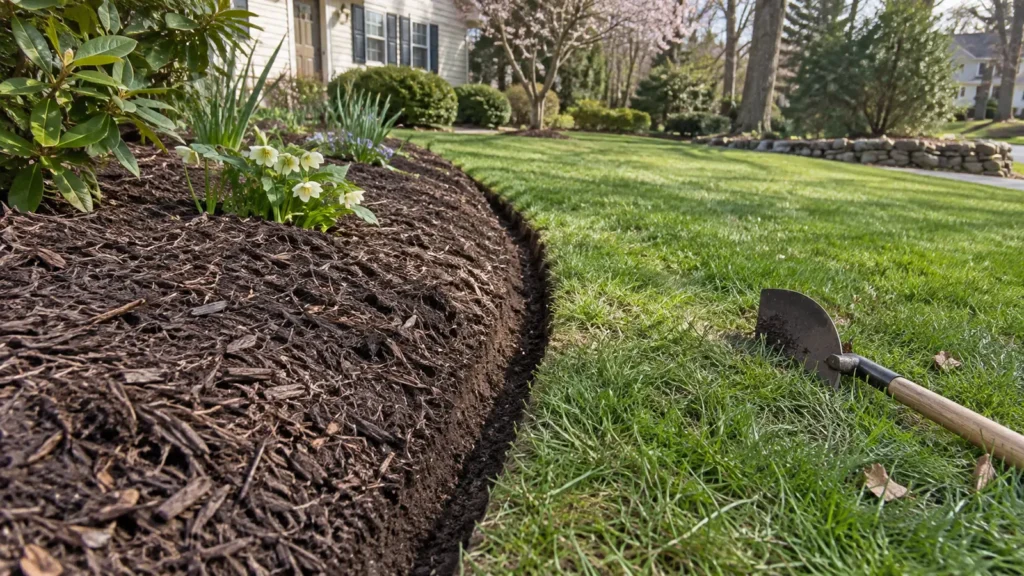
Drive any Main Line street the week after mulch season and you’ll see two kinds of beds. One has rich color and a clean line where turf stops. The other has the same mulch color—already migrating onto the walk, mixed with grass runners, and feathered into a muddy fringe.
The difference usually isn’t the mulch brand. It’s the edge.
What a bed edge actually is
A bed edge is the boundary that separates planting area from lawn (or from walk and drive). It’s both a look and a working shoulder.
Common forms on residential lots:
- Cut edge / trench edge — a shallow trench spaded or edged so mulch sits down slightly and grass roots are severed at the line
- Hard edge — steel, stone, brick, or concrete restraint
- Soft “visual” edge — mulch simply stops where the crew got tired, with no trench or restraint
That last one is what people accidentally buy when the quote only says “mulch delivery and spread.” Color shows up. Structure doesn’t.
Why dumping mulch without an edge fails quickly
Without a defined shoulder, several things happen on our local properties:
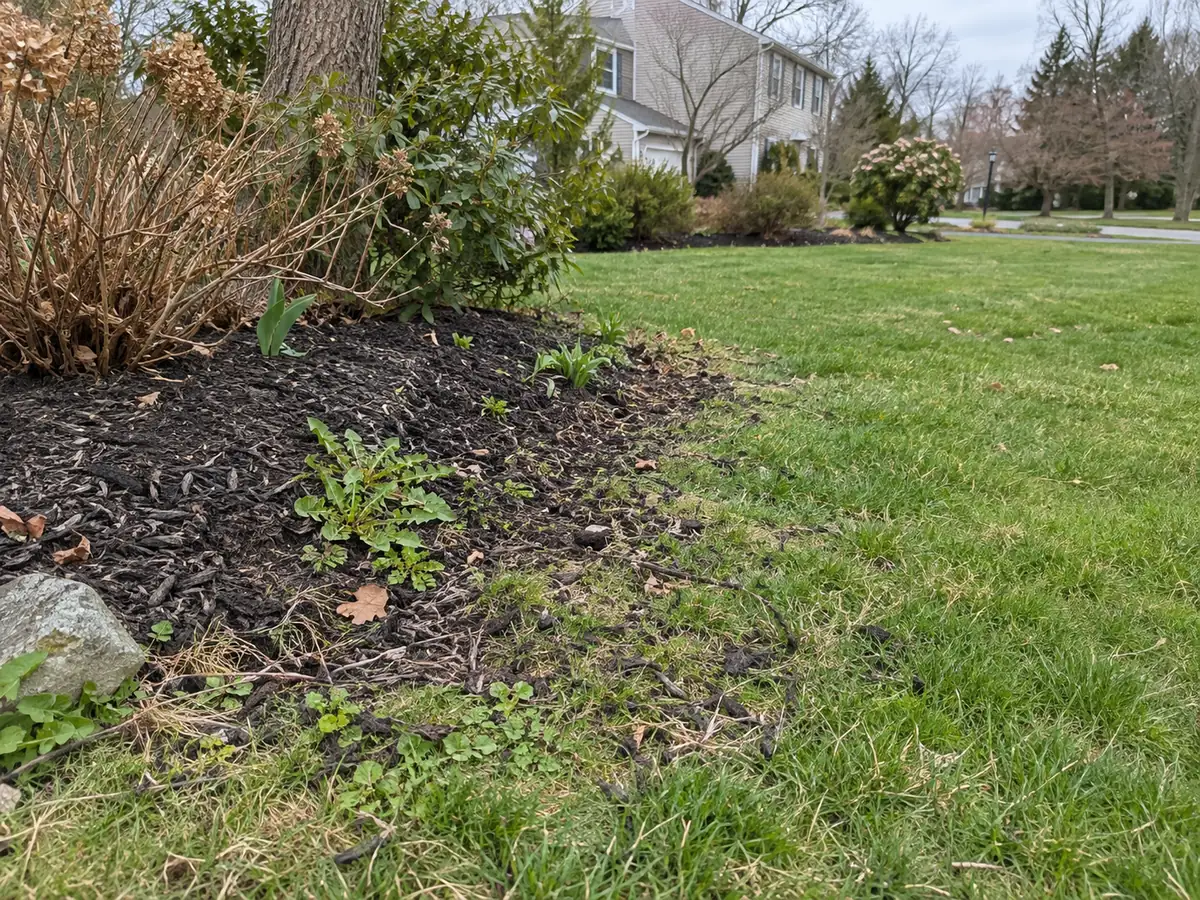
Grass creeps in. Cool-season turf sends runners and seed into the mulch. Within a season the bed line looks chewed.
Mulch creeps out. Rain, downspouts, and foot traffic push chips onto walks and into the mower path. Then the mower scatters them further or chops them into the lawn.
String trimmers erase the line. When grass and mulch meet in a fuzzy zone, trimming either scalps the bed or leaves a fringe of long grass. Crews can’t win that weekly battle.
Weeding gets harder. A clean edge makes it obvious what’s bed and what’s lawn. A blended strip becomes a permanent weed nursery.
Fresh mulch on a collapsed edge is a short-term photo fix. The geometry underneath still decides how the bed ages.
Finish quality vs. coverage quality
Homeowners often judge mulch day by color and depth. Those matter. Finish quality includes more:
- Line consistency (smooth curves or intentional straight runs, not wavy accidents)
- Depth held inside the line, not feathered thin at the perimeter
- Mulch kept off trunks and crowns
- Walks and drives blown clean so the edge reads clearly
- Grass clippings not left glued to the new mulch surface
You can have adequate cubic yards and still get a weak finish. You can also have a strong edge with a modest top-up and the bed will look intentional longer.
When you compare mulching services, ask what happens at the perimeter—not only how many yards land in the middle.
How edging helps lawn care, not just beds
A sharp bed line speeds every later mowing visit. The mower has a clear stop. Trimming is faster and less likely to nick shrubs. Clippings are less likely to bury the first foot of bed.
On compact Montgomery County lots, beds often sit close to walks and foundations. That proximity makes edge quality visible from the street and from the front door. It’s one of the cheapest ways to make routine lawn care look more polished without changing anything about the turf itself.
When to re-cut an edge
Edges aren’t eternal. Soil slumps, freeze–thaw softens trenches, and traffic collapses shoulders.
Consider redefining the edge when:
- You can see a wide blended strip of grass-in-mulch
- Mulch regularly washes onto hardscape after storms
- The bed shape has slowly grown or shrunk without anyone deciding it should
- You’re about to install a full fresh mulch layer anyway
Re-edging before mulch is more efficient than mulching first and carving later (which spills new mulch into the lawn).
Hard edges need inspection too: heaved brick, poking steel, or gaps where weeds colonize the joint.
Practical decision points before you book mulch
- Is the current line where you want it? Move the line on purpose, not by accident over three seasons.
- Trench edge or hard restraint? Trench edges are common and renewable; hard edges cost more up front and change the maintenance pattern.
- Who cuts the edge—same crew as mulch? Ideally yes, same visit, same standard.
- Any downspouts dumping into the bed? Those spots may need a deeper shoulder, stone splash, or grading attention; mulch alone won’t hold.
- Shade and thin turf along the perimeter? Weak grass at the edge still creeps; the trench still helps, but don’t expect miracles if the lawn is bare mud.
What “done” looks like on mulch day
Walk the perimeter when the crew finishes. You should see a continuous line, mulch held behind it, and hard surfaces cleaned. Gaps at corners, thin halos around every shrub, and a tide line of chips on the sidewalk mean the middle got attention and the edge didn’t.
If something’s off, it’s easier to fix before the truck leaves than after the mulch settles and the route moves on.
Ask for the edge, not only the color
Worthy Landscaping treats bed edges as part of a proper mulch finish—not an optional flourish—for homes we serve across Montgomery, Delaware, and Chester Counties and the Main Line / western Philadelphia suburbs.
If your beds look tired even after recent mulch, the perimeter may be the real issue. Reach out via contact us, email contactus@worthylandscaping.com, or call (215) 490-8474. We’re at 427 Jefferson Street, Bridgeport, PA 19405. We can look at the line you have and tell you whether a re-edge, a top-up, or both will get the result you want.